A growing number of American pastors are turning to artificial intelligence for research and structure work — not to write sermons, but to reclaim the hours lost to preparation each week.
Pastor, you know the routine.
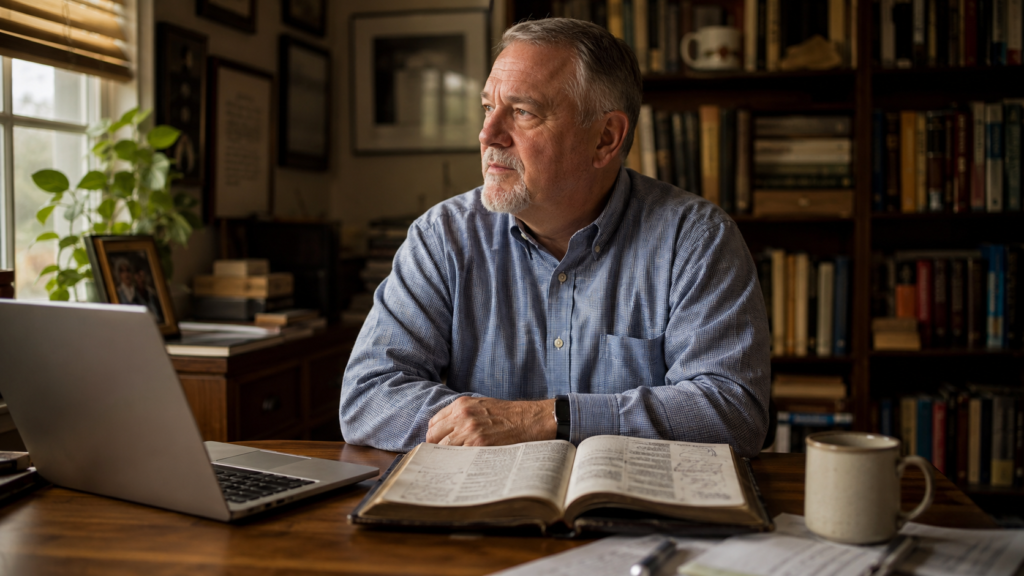
It’s Friday afternoon and the office door is closed. Three commentaries are open on the desk. The Greek lexicon is somewhere under a stack of notes. You have a rough outline, but the illustrations feel flat, the application section needs more work, and the introduction still hasn’t come together. Sunday is 48 hours away and you haven’t written a word of substance yet.
This is not an exaggeration. Lifeway Research found that the average pastor spends 10 to 15 hours preparing a single sermon — and that number climbs to 20 hours for those preaching multiple times per week. Another study from the Schaeffer Institute reported that 70 percent of pastors feel their energy depleted by Saturday night, right when their families need them most. A 2023 Barna study found that nearly 6 in 10 pastors say sermon preparation is their single biggest weekly challenge — ahead of counseling, administration, and fundraising combined.
Over a year, the numbers compound dramatically. At 15 hours per week for 48 preaching weeks, a pastor spends roughly 720 hours annually on sermon preparation alone — the equivalent of 18 full-time work weeks. For a bivocational pastor juggling a second job, the math becomes unsustainable. The same Lifeway study found that more than 60 percent of pastors report their preparation workload has increased over the last five years, driven by congregational expectations for deeper, more engaging messages.
The math is unforgiving. Subtract sermon prep from hospital visits, counseling sessions, staff meetings, and the emergencies that come with shepherding a congregation, and something has to give. For many, what gives is depth of preparation. Or family time. Or both. Research from the Hartford Institute for Religion Research found that one in three pastors reports that sermon preparation routinely interferes with family commitments — a factor linked to the 40 percent of pastors who have considered leaving ministry in the past twelve months, according to a separate Barna survey.
If any of this sounds familiar, you are not alone — and you are not failing. The model simply hasn’t changed in decades. Until now.
• • •
Artificial Intelligence Enters the Church Study
Over the past eighteen months, artificial intelligence has moved beyond Silicon Valley and into the local church. Not as a gimmick. Not as a replacement for the Holy Spirit’s guidance. But as a research and organization tool that functions much like a commentary — except faster, broader in scope, and able to cross-reference scripture in seconds rather than hours.
Early adopters describe it less like a robot writing sermons and more like having a well-read research assistant who organizes your thoughts before you sit down to write. A 2024 Barna Group survey noted that 28 percent of Protestant pastors reported using some form of AI in sermon preparation — up from single digits just two years prior. At that adoption rate, the majority of American pulpits will be AI-supported within five years. Separately, a 2025 survey by Gloo, a technology platform serving over 50,000 churches, found that 41 percent of church leaders now say they are “open to exploring” AI-assisted tools for ministry — a figure that sat below 15 percent in 2022.
Several platforms have emerged to fill this need — ranging from general-purpose chatbots adapted for Bible study to specialized sermon preparation tools built from the ground up for pastoral workflow. The most interesting category, according to church technology analysts, is the latter: platforms designed specifically around how pastors actually prepare, rather than generic tools repurposed for ministry. These specialized tools accounted for 62 percent of ministry-focused AI adoption in Gloo’s most recent survey, suggesting that pastors prefer purpose-built solutions over generic alternatives.
Dr. Thomas Bergler, professor of ministry studies at Azusa Pacific University, put it this way in a recent interview: “Every generation of pastors has adopted new tools — concordances, Bible software, digital libraries. AI is the next tool, not the next pastor.” The real question, Bergler added, is not whether pastors will adopt AI, but which tools will prove most useful in the unique context of sermon preparation.
The distinction matters: AI does not preach the sermon. The pastor does. It does not pray. It does not feel the weight of a congregation’s needs. What it does is eliminate the mechanical parts of preparation — the cross-referencing, the outline drafting, the hunt for illustrations — so the pastor can focus on the parts only a human can do: prayer, application, and delivery.
• • •
What It Looks Like in Practice: A Five-Step Sunday
To understand how these tools work in the real world, Ministry Today spent time with pastors who use Pastor Rhema, one of the platforms gaining traction among American clergy. The tool — a web-based application accessible from any device — guides users through a five-step workflow designed around how pastors naturally prepare a message.
The first step is Bible study: the pastor enters a passage, and the platform surfaces original language insights, historical context, and cross-references from multiple translations. The second step builds a sermon structure — a logical outline the pastor can refine, reorder, or rebuild entirely. Step three generates illustrations, drawing from biblical typology, historical examples, and contemporary analogies that connect the ancient text to a modern congregation. Step four focuses on application — specific, actionable takeaways that move beyond generalities. The final step produces a complete manuscript the pastor owns, edits, and delivers as their own.
James Carter, who has pastored a Baptist congregation in rural Texas for 15 years, described what the shift looked like in his weekly rhythm. “I used to spend my entire Friday and Saturday buried in commentaries and staring at a blank page,” Carter said. “My wife finally told me she felt like a widow every weekend.” After adopting the tool, Carter says his preparation time dropped from roughly 12 hours to two. “That’s ten hours back — every single week. I’m making hospital visits again. My kids know their dad on Saturdays now.”
Doing the math: ten hours reclaimed per week, multiplied by 48 preaching weeks, equals 480 additional hours per year — the equivalent of twelve full work weeks returned to a pastor’s calendar. For Carter, that translated to recovered family time, renewed pastoral availability, and, he reports, a measurable drop in his own stress levels.
The platform also includes an interactive Bible that allows pastors to explore passages with guided questions, an AI chat for theological and practical queries during preparation, and a pastoral counseling module designed to help with common ministry scenarios. The underlying philosophy is that technology should serve the calling, not compete with it.
I used to spend my entire Friday and Saturday buried in commentaries and staring at a blank page. My wife finally told me she felt like a widow every weekend. I cut my prep from twelve hours down to about two. That’s ten hours back — every single week. I’m making hospital visits again. My kids know their dad on Saturdays now.
Pastor James Carter
Baptist congregation, rural Texas. 15 years in ministry.
• • •
“I Thought AI Had No Place Near the Pulpit”
Not everyone was an early believer. Rev. David Kim, a Presbyterian minister in Southern California, was initially opposed to the idea. “I thought AI had no place near the pulpit,” Kim said. “I only tried it because a colleague I respect insisted.” What he found surprised him. “Pastor Rhema doesn’t touch the spiritual work. It handles the academic legwork — the word studies, the outlining, the historical context. It’s like having a research assistant who works at three in the morning and never needs a day off.” Kim now uses the platform weekly.
His reaction mirrors a broader pattern among clergy who were initially skeptical. A common theme across interviews: the tool saves time, deepens research, and produces sermons that are better organized — without altering the pastor’s voice or theological convictions. The pastor remains the author. The tool handles the scaffolding.
Pastor Marcus Webb leads a non-denominational church of about 200 members outside Atlanta. He noticed something he had not experienced in ten years of preaching: congregants commenting on clarity and structure without being prompted. “Three people came up to me after service last month and said it was the clearest message they’d ever heard me give,” Webb said. “That’s not a compliment to me — that’s what happens when the scaffolding is right. Pastor Rhema gives me the scaffolding. I still have to build the house.”
Three people came up to me after service last month and said it was the clearest message they’d ever heard me give. That’s not a compliment to me — that’s what happens when the scaffolding is right. Pastor Rhema gives me the scaffolding. I still have to build the house.
Pastor Marcus Webb
Non-denominational church of ~200 members outside Atlanta, Georgia.
• • •
What It Costs and Where to Find It
Pastor Rhema is available as a web application that works on any device — phone, tablet, or desktop. The platform offers a one-time $39 lifetime access fee for the core version, which covers the five-step sermon workflow, interactive Bible, AI chat, and counseling module. A premium tier, Pastor Rhema Plus, adds advanced features at $19 per month. A seven-day free trial is available without requiring a credit card upfront.
For context, $39 is roughly the cost of a single academic commentary — the kind many pastors already purchase for their libraries. The difference, users say, is that a commentary helps with one passage per week, while the platform assists across the entire preparation workflow for every sermon. At 48 sermons per year, the math places the per-sermon cost at approximately 81 cents — less than the price of a cup of coffee at a diner, and a fraction of what most pastors spend on printed resources, Bible software subscriptions, or continuing education materials each year.
“It’s not about replacing the spiritual discipline of study,” Carter said. “It’s about getting the mechanical work done faster so I can spend more time on the parts that actually require me — prayer, personal application, and being present with my people.”
An increasing number of churches — from small rural congregations to suburban megachurches — are quietly integrating AI-assisted preparation into their weekly workflow. The pastors we spoke with described it as one of the more meaningful efficiency gains they have made in years of ministry. As of May 2026, an estimated 15,000 pastors are actively using the platform, according to the company.
Pastor Rhema is available at pastorrhema.com. A seven-day free trial is included — no credit card required.
How we reported this story
Ministry Today spoke with three pastors who use the platform regularly, reviewed the tool over a two-week period for research purposes, and consulted published surveys and studies from Lifeway Research, the Barna Group, the Schaeffer Institute, the Hartford Institute for Religion Research, and Gloo. Additional context was provided through interviews with academic researchers studying technology adoption in ministry settings. The pastors interviewed were identified through the platform’s user community; their experiences reflect individual results and may not be typical of all users.