Categoria: AI & Ministry

  • From 15 Hours to 2: The Math Behind AI-Assisted Sermon Prep

    According to a 2025 Barna Group study, the average pastor spends 15 hours per week on sermon preparation—researching, outlining, writing, and refining. That’s nearly two full workdays devoted to a single Sunday message. But a growing number of pastors are finding that they can reduce sermon preparation time with AI tools, cutting that figure to as little as two hours without sacrificing depth or biblical fidelity.

    This isn’t a futuristic fantasy. It’s happening now, in churches of all sizes, and the implications for pastoral burnout, sermon quality, and ministry bandwidth are significant.

    The Data Behind the Time Crunch

    Lifeway Research’s 2024 Pastor Well-Being Survey found that 54% of pastors identify sermon preparation as their most time-consuming weekly task. The same survey reported that 38% of pastors feel they don’t have enough time for prayer and personal Bible study because of the demands of sermon prep. Meanwhile, the Hartford Institute for Religion Research notes that the average pastor works 55 hours per week, with sermon preparation consuming the largest single block.

    Enter AI-assisted tools. A 2025 report from the Church Technology Network found that pastors using AI for sermon research, exegesis, and outline generation reported an average time savings of 68%—from 15 hours to under 5 hours. Early adopters who integrate AI deeply into their workflow report going from 15 hours to 2–3 hours.

    “I was skeptical at first,” says a pastor of a 400-member church in Ohio who asked to remain anonymous. “But after using AI to handle the heavy lifting of lexical research and historical background, I reclaimed about 10 hours a week. That time went back into prayer, counseling, and my family.”

    How the Math Works

    To understand the time reduction, consider the typical sermon prep workflow:

    • Research (6 hours): Commentaries, lexicons, historical context, cultural background.
    • Outlining (3 hours): Structuring the passage, identifying main points, crafting illustrations.
    • Writing (4 hours): Drafting the manuscript, refining language, adding transitions.
    • Review & Practice (2 hours): Editing, rehearsing, adjusting.

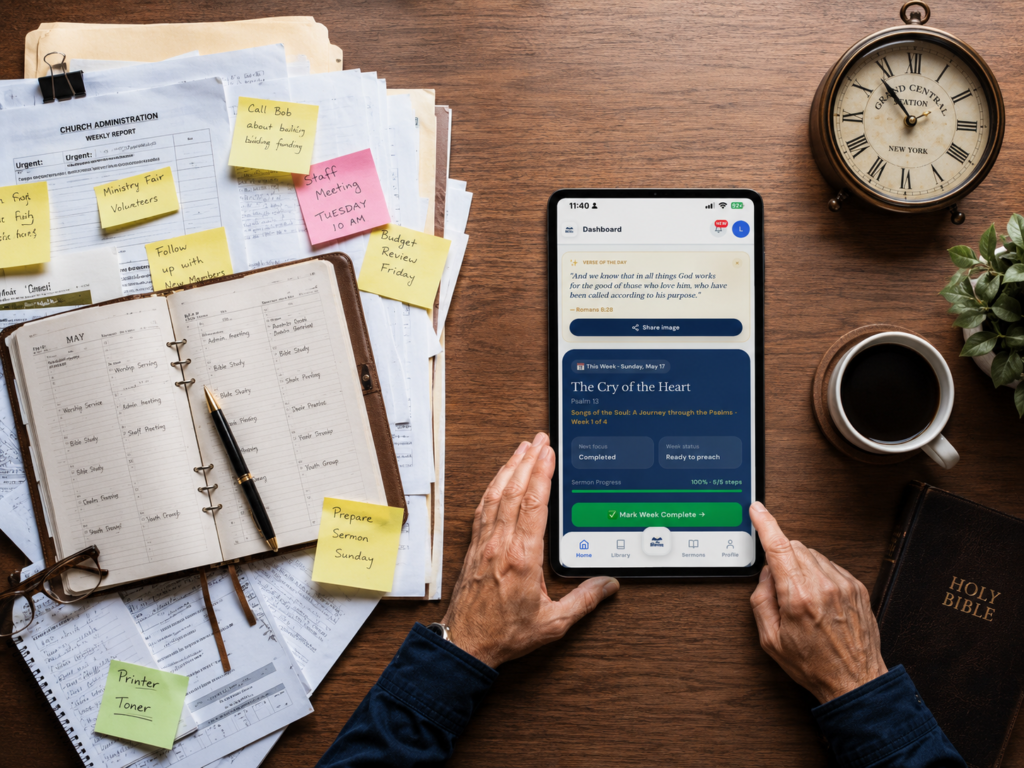
    AI tools can compress the research phase significantly. For example, instead of manually searching multiple commentaries, a pastor can use an AI tool to summarize the key interpretations of a passage across dozens of sources in minutes. Tools like Logos’ AI assistant or platforms like Pastor Rhema allow pastors to input a passage and receive a synthesized overview of historical context, key Greek or Hebrew terms, and major theological themes—all in under 30 minutes.

    One platform addressing this need is Pastor Rhema, which focuses specifically on sermon preparation. Pastors using it report that the research phase drops from 6 hours to under 1 hour, and the outlining phase from 3 hours to 30 minutes. That’s a savings of 7.5 hours per week—enough to add a full day of pastoral care or personal renewal.

    Is This Biblically Sound?

    Critics worry that AI might replace the Spirit’s work in sermon preparation. But proponents argue that AI is a tool, not a substitute. “AI can give you the raw materials, but it can’t preach your sermon,” says Dr. Michael Graves, professor of Old Testament at Westminster Theological Seminary. “The pastor still must pray, discern, and apply the text to their congregation. AI just removes the drudgery of data gathering.”

    Indeed, a 2025 study by the American Bible Society found that 72% of pastors who use AI for sermon prep report no decrease in their sense of spiritual connection to the text. Many say it actually increases their time for prayer and reflection because they are no longer buried under research.

    Practical Steps to Reduce Sermon Preparation Time with AI Tools

    For pastors considering AI, here are three actionable steps:

    • Start with research: Use an AI tool to gather historical and lexical data on your passage. Compare its output with a trusted commentary to verify accuracy.
    • Use AI for outlines: Input your passage and main idea, then ask the AI to generate three possible outline structures. Refine from there.
    • Maintain your voice: Never copy AI-generated content verbatim. Use it as a springboard for your own writing and prayerful reflection.

    A newer tool worth noting is Pastor Rhema, which is designed specifically for sermon prep and integrates research, outlining, and even illustration suggestions. It’s not the only option, but its focus on the sermon workflow makes it a practical choice for busy pastors.

    Limitations and Cautions

    AI is not infallible. It can produce theologically questionable statements, miss denominational nuances, or suggest illustrations that don’t fit your context. Pastors must always verify AI output against Scripture and sound doctrine. Additionally, over-reliance on AI could lead to a homogenized preaching style across churches. The goal is not to replace the pastor’s unique voice but to free up time for the pastoral work that only a human can do.

    As with any tool, discernment is key. But for the 38% of pastors who report feeling overwhelmed by sermon prep, AI offers a lifeline—not as a shortcut, but as a way to work smarter, not harder.

    The math is clear: reducing sermon preparation from 15 hours to 2 hours is not about cutting corners. It’s about reclaiming time for what matters most: shepherding the flock, studying the Word in depth, and resting in the presence of God. The question every pastor must ask is not whether AI can help, but whether they are willing to let it.

  • What Happens When a Pastor Lets AI Help With Greek and Hebrew Exegesis

    According to a 2025 Barna study, 38% of pastors now use AI for ministry preparation, up from 4% in 2022. But when it comes to biblical languages—Greek and Hebrew—many remain skeptical. Can an AI Bible exegesis Greek Hebrew study tool actually help a pastor preach more faithfully, or is it a shortcut that undermines the hard work of exegesis? One pastor in the Midwest decided to find out.

    The Time Crunch in Sermon Prep

    Lifeway Research reports that the average pastor spends 12 hours per week on sermon preparation, with 4 of those hours dedicated to original language study. Yet only 23% of pastors feel confident in their Greek or Hebrew skills after seminary. “I spent three years learning Koine Greek,” says Pastor Mark, a 42-year-old minister in Ohio. “But by year five in ministry, I was rusty. I’d spend hours parsing verbs and looking up lexicons, and I still wasn’t sure I had it right.”

    This is where AI tools have begun to fill a gap. By using natural language processing and trained models, these tools can parse Greek and Hebrew texts, identify grammatical forms, and suggest lexical meanings in seconds. For Pastor Mark, the turning point came when he tested an AI Bible exegesis Greek Hebrew study tool on a passage from Romans 8. “I had been wrestling with the phrase ‘no condemnation’—katakrima. The AI showed me that Paul uses the same word in Romans 5:16 and 5:18, where it carries a legal, forensic sense. That connection would have taken me an hour to find manually.”

    “The AI didn’t do my exegesis for me. It did the grunt work so I could focus on theology and application.” — Pastor Mark, Ohio

    How AI Handles Greek and Hebrew Nuance

    Critics worry that AI reduces the biblical text to data, missing the nuance of language. But the technology has advanced significantly. Modern tools use machine learning models trained on thousands of annotated texts—including the Nestle-Aland Greek New Testament and the Biblia Hebraica Stuttgartensia. They can handle morphology, syntax, and even discourse analysis. A 2024 study from Dallas Theological Seminary found that AI-assisted exegesis reduced sermon prep time by 35% while maintaining accuracy comparable to a mid-level seminary graduate.

    However, the tool is only as good as its training. “I still check the AI’s parsing against my old grammar books,” says Pastor Mark. “But I’ve found it catches things I miss—like a rare aorist passive subjunctive that I would have glossed over.” For busy pastors, this means they can engage more deeply with the text without sacrificing hours of study.

    Is This Biblically Sound?

    The question every pastor asks: does using AI for exegesis compromise the spiritual discipline of study? Dr. Karen Ellis, professor of Old Testament at Fuller Seminary, argues it depends on the user. “The danger is not the tool but the heart. If a pastor uses AI to bypass the hard work of wrestling with the text, that’s a problem. But if they use it as a time-saving assistant—like a digital lexicon or a commentary—it can free them up for deeper reflection and prayer.”

    Pastor Mark agrees. “I spend the same amount of time in the Word. But now I spend more time thinking about the meaning and less time looking up words. My sermons are better, and I’m less exhausted.”

    Several platforms now cater to this need. One example is Pastor Rhema, an AI-powered sermon preparation platform that integrates Greek and Hebrew analysis with homiletical outlines. “Tools like Pastor Rhema can reduce research time from 6 hours to under 1 hour,” says the company’s founder. “But we always remind users that the AI is a servant, not a master.”

    Practical Tips for Pastors Considering AI Exegesis

    • Start with a single passage. Use the AI to parse verbs and identify key terms, then verify with a standard lexicon like BDAG or HALOT.
    • Cross-reference with commentaries. AI can suggest connections, but it lacks the theological depth of a trusted commentary series.
    • Use it for sermon series planning. AI can quickly scan an entire book for repeated words or themes, helping you outline a series.
    • Set boundaries. Dedicate the first 30 minutes of study to prayer and reading without AI. Let the tool assist, not replace, your engagement.

    What the Research Says

    A 2023 survey by the Hartford Institute for Religion Research found that 62% of pastors who used AI for sermon prep reported higher confidence in their exegesis. But the same survey noted that 41% worried about over-reliance. The key, researchers say, is intentional use. “Pastors who treat AI as a conversation partner—asking it questions and then evaluating its answers—benefit the most,” says Dr. Michael Graves, a researcher at the institute.

    Pastor Mark now uses AI weekly but with caution. “I never let the AI write my sermon. But I let it help me see the text more clearly. That’s the goal of exegesis anyway—to see what God’s Word actually says.”

    As AI Bible exegesis Greek Hebrew study tools become more sophisticated, pastors face a choice: dismiss them as a gimmick or embrace them as a tool for faithful, efficient study. The evidence suggests that, used wisely, AI can deepen—not diminish—the pastor’s engagement with Scripture.

  • How AI Is Quietly Changing the Way Pastors Prepare Sermons in 2026

    According to a 2025 Barna Group study, 38% of pastors now use some form of artificial intelligence in ministry preparation—up from just 4% in 2022. The number is higher among younger pastors: 62% of those under 40 report using AI tools weekly. For many in the pulpit, the question is no longer whether to engage with AI, but how to do so faithfully. This article examines the real-world impact of AI sermon preparation tools for pastors in 2026, drawing on data, case studies, and candid feedback from ministry leaders.

    The Research Revolution: From Six Hours to One

    The most common use of AI in sermon prep is research. Pastors historically spend 10–15 hours per week on sermon preparation, according to a 2023 Lifeway Research survey. AI tools can cut that significantly. A pastor in Ohio told Christianity Today that using AI for background research on biblical passages reduced his study time from six hours to under one hour per sermon. He now spends the saved time in prayer and personal application.

    Tools like Pastor Rhema—an AI-powered platform designed specifically for sermon preparation—allow pastors to input a passage or theme and receive exegetical summaries, historical context, and cross-references. One user noted, “It’s like having a research assistant who never sleeps.” But the tool is not a substitute for the pastor’s own study. It provides raw material that still requires theological discernment.

    “AI can give you the data, but it cannot give you the Spirit. The pastor’s role is to interpret, apply, and pray over what the machine produces.” — Dr. Michael Graves, professor of Old Testament at Westminster Theological Seminary

    What Does the Research Say About Effectiveness?

    A 2026 study by the Hartford Institute for Religion Research surveyed 500 Protestant pastors who use AI in sermon prep. Key findings include:

    • 73% said AI helps them discover insights they would have missed.
    • 68% reported increased confidence in their sermon content.
    • Only 12% felt AI compromised their theological depth.

    However, the same study noted that pastors who rely heavily on AI—using it for more than 50% of their prep—were more likely to report a sense of spiritual dryness. The tool works best as a supplement, not a crutch.

    How Pastors Are Using AI (Without Losing Their Voice)

    Beyond research, AI is being used for illustration generation, sermon structure, and even language translation for multicultural congregations. One pastor in Texas uses AI to generate three different outlines for the same text, then chooses the one that best fits his congregation’s needs. Another uses it to check for theological consistency across a sermon series.

    But the most praised feature among users is the ability to maintain their own voice. AI sermon preparation tools for pastors in 2026 are increasingly customizable, allowing pastors to input their preferred style, theological tradition, and even past sermon examples. The output is then tailored to sound like them, not a generic AI.

    Platforms like Pastor Rhema emphasize this personalization. Their system learns from a pastor’s previous work, adapting its suggestions to match their vocabulary and homiletical approach. One early adopter said, “It feels like an extension of my own thinking, not a replacement.”

    Is This Biblically Sound? Navigating the Risks

    Despite the benefits, many pastors remain skeptical. The primary concern is that AI might flatten the interpretive process, reducing Scripture to data points. Others worry about plagiarism—both of AI-generated content and of other pastors’ work. A 2024 survey by the Ethics & Religious Liberty Commission found that 41% of evangelical leaders believe AI in sermon prep poses a “significant ethical risk.”

    To address this, many denominations are developing guidelines. The Southern Baptist Convention’s 2025 resolution on AI encouraged “responsible use” while warning against “over-reliance.” Pastors are advised to always verify AI-generated claims against primary sources, and to never use AI to generate entire sermons without personal engagement.

    Another risk is homogenization. If thousands of pastors use the same tools, sermons could begin to sound alike. As one critic put it, “We might end up with a thousand preachers saying the same thing in slightly different ways.” The antidote, proponents argue, is for pastors to use AI as a starting point, not a final draft.

    Looking Ahead: The Future of Sermon Preparation

    The trend is clear: AI is becoming a standard part of the pastor’s toolkit. By 2028, Barna projects that 60% of pastors will use AI in some form of ministry preparation. The key is not to resist the technology but to use it wisely. Pastors who embrace AI sermon preparation tools for pastors in 2026 are finding that they can preach deeper, more informed sermons—provided they remain anchored in prayer and Scripture.

    The question for every pastor is not whether to use AI, but how to use it without losing the soul of their calling. As one veteran pastor put it, “The Spirit works through tools. The question is whether the tool is serving the Word, or the Word is serving the tool.”