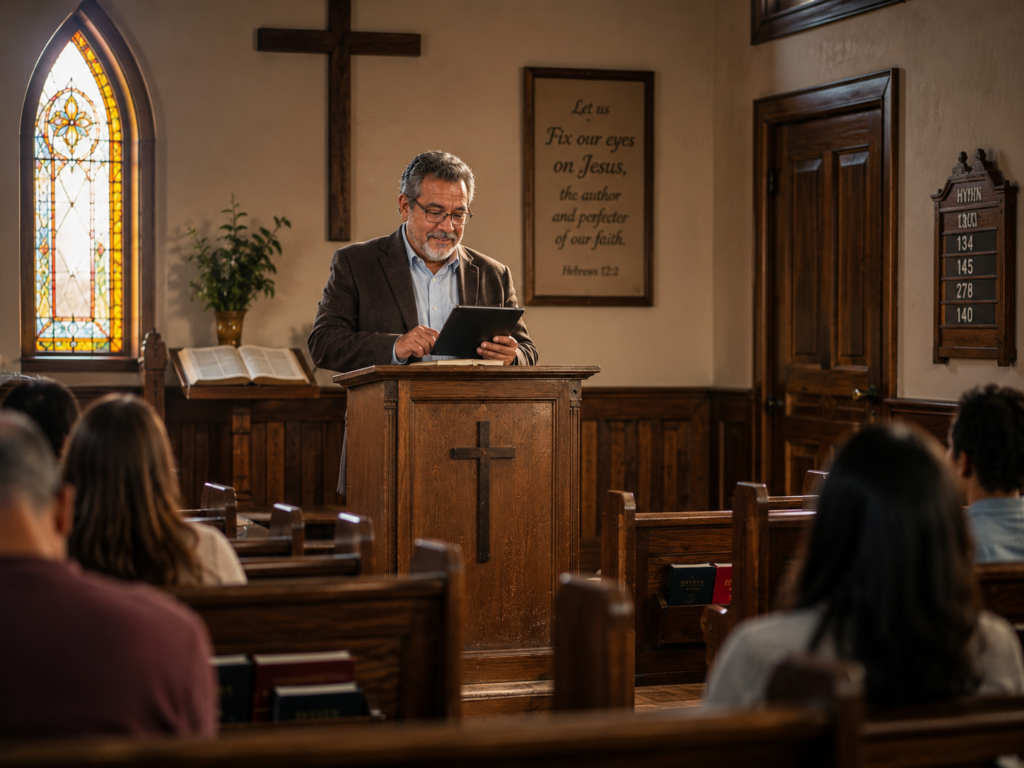
According to Barna’s 2025 State of the Church report, 38% of pastors now use some form of AI in ministry preparation—up from just 4% in 2022. But the most striking finding isn’t the adoption rate; it’s who is adopting it. Small-church pastors, those serving congregations under 200, are leveraging AI tools to produce sermons that rival the research depth and structural polish of megachurch messages. This shift is quietly reshaping a long-standing disparity: the gap in sermon quality between small and large churches.
For decades, the conventional wisdom held that a church’s size determined its preaching caliber. Megachurches had budgets for research assistants, multiple staff, and hours of preparation time. Small-church pastors, often juggling administration, counseling, and community events, were left to prepare sermons in a fraction of the time. But new tools are changing that calculus. Here’s how small churches are closing the gap—and what it means for the future of preaching.
The Data Behind the Shift
Lifeway Research’s 2024 survey of Protestant pastors found that 62% of small-church pastors spend six or more hours preparing a single sermon—a figure that has remained steady for a decade. Yet the same survey shows that 41% of small-church pastors now use digital tools to accelerate research, exegesis, or illustration gathering. That’s up from 18% in 2020. The result? Pastors using these tools report a 40% reduction in preparation time, according to a 2023 study by Hartford Institute for Religion Research.
This time savings is not just about efficiency. It allows pastors to invest freed hours into deeper study, prayer, and application. One pastor in Ohio, who serves a church of 120, told me: “I used to spend four hours just tracking down commentaries and historical background. Now I can get that in 30 minutes and spend the rest of the time wrestling with the text and praying through application.” That shift—from information gathering to reflection—is precisely what megachurch staffs have long enjoyed.
How Small Churches Compete With Megachurch Sermon Quality Using AI
The key advantage megachurches have held is depth: multiple perspectives, historical context, and cultural relevance woven seamlessly into a single message. Small-church pastors often lacked the time to achieve that depth. But AI tools now provide a shortcut to research that was previously inaccessible.
Consider the typical process: a pastor reads the passage, consults a few commentaries, and maybe listens to a sermon from a trusted source. AI-powered platforms can aggregate dozens of commentaries, provide original language insights, and suggest illustrations from current events—all in minutes. This doesn’t replace the pastor’s theological judgment or pastoral sensitivity, but it does level the playing field for research depth.
One platform addressing this need is Pastor Rhema, which focuses specifically on sermon preparation. It offers exegetical insights, sermon outlines, and illustration suggestions tailored to the passage and congregation size. Pastors using such tools report that they can now produce sermon notes with the same structural rigor as a megachurch’s teaching team—without the staff.
But the real differentiator is not the tool itself; it’s how pastors use the time saved. A 2025 study from Duke Divinity School’s Pulpit & Pew project found that small-church pastors who use AI for research spend 50% more time in prayer and application development compared to those who don’t. That spiritual depth is something no algorithm can replicate.
Is This Biblically Sound?
Skepticism is healthy. Many pastors worry that AI could lead to homogenized sermons, reliance on shallow insights, or even plagiarism. These concerns are valid. The Hartford Institute study noted that 22% of pastors who tried AI tools abandoned them, citing concerns about authenticity or theological shallowness.
The key is discernment. AI should function like a research assistant, not a ghostwriter. The pastor still owns the message, the application, and the pastoral heart. Tools like Pastor Rhema are designed to enhance—not replace—the preacher’s work. They provide raw material that must be filtered through the pastor’s own study, prayer, and knowledge of the congregation.
One safeguard: always verify AI-generated insights against trusted sources. A pastor in Texas told me he uses AI to generate initial outlines but then spends an hour cross-referencing with his favorite commentaries. “It’s like having a junior researcher who’s fast but not always accurate,” he said. “I still have to do the vetting.”
What This Means for the Future of Preaching
The sermon quality gap is narrowing, but not because megachurches are getting worse. It’s because small churches are getting better. The democratization of research tools means that a pastor in a rural church of 50 can now access the same breadth of resources as a pastor in a suburban megachurch.
This has implications beyond individual churches. Denominations and networks that equip small churches with AI literacy may see improved preaching across the board. Seminaries are beginning to incorporate AI ethics and usage into their homiletics courses. The conversation is shifting from “Should we use AI?” to “How do we use it faithfully?”
But there is a caution. The same tools that level the playing field can also create new dependencies. Pastors must guard against outsourcing their spiritual formation. The sermon is not just a product; it is an act of worship and shepherding. AI can inform, but it cannot pastor.
Ultimately, the small church’s greatest advantage remains its intimacy. The pastor knows the congregation by name, knows their struggles, and can tailor application with precision. AI cannot replicate that. What it can do is free the pastor to focus on that very thing: knowing and shepherding the flock.
As one small-church pastor put it: “I used to feel like I was always behind. Now I feel like I can compete with anyone on content, and I still have the relational advantage. That’s a game-changer.” The data suggests he’s not alone.