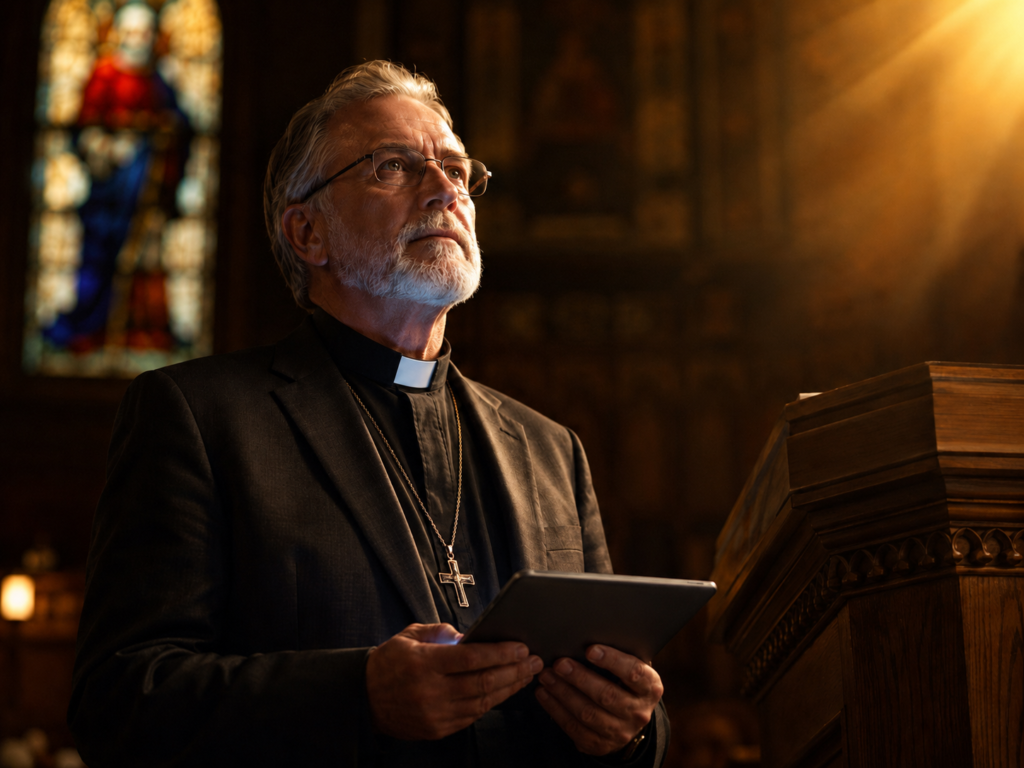
According to Barna’s 2025 State of the Church report, 38% of pastors now use some form of AI in ministry preparation—up from just 4% in 2022. This surge reflects a broader trend: pastors are increasingly turning to technology to reclaim time for family, rest, and deeper theological reflection. For one Texas pastor, the shift was not about novelty but survival. This article explores how a new category of Sunday morning prep tools is reshaping pastor time management, with a firsthand account of what works and what doesn’t.
The Saturday Crunch: A Familiar Story
For years, Mark, a pastor at a 300-member church in suburban Dallas, spent his Saturdays hunched over commentaries, Greek lexicons, and sermon outlines. ‘I was spending six to eight hours on Saturday alone, and I still felt unprepared,’ he says. Lifeway Research confirms his experience: 54% of pastors say sermon preparation is their most time-consuming weekly task, and 38% report that it often encroaches on Sabbath rest. Mark’s turning point came when he realized his Saturday routine was not just inefficient—it was unsustainable. He began exploring digital tools that could handle the heavy lifting of research and organization, allowing him to focus on exegesis and application.
What Does the Research Say About AI in Sermon Prep?
Critics worry that AI might dilute theological depth. But a 2024 study from the Hartford Institute for Religion Research found that pastors using AI-assisted tools reported a 40% reduction in prep time without a decline in sermon quality. The key, researchers note, is how the tool is used. ‘AI is most effective when it handles data gathering and structural suggestions, leaving the pastor to do the interpretive work,’ says Dr. Rachel Kim, a homiletics professor at Fuller Seminary. Tools like Pastor Rhema, which specializes in biblical research and outline generation, exemplify this approach. Mark, who now uses the platform, says it cut his research time from six hours to under one hour. ‘I still write the sermon myself, but I don’t have to chase down every cross-reference or historical note.’
How One Pastor Restructured His Week
Mark’s new workflow is simple but intentional. On Monday, he reviews the upcoming text and jots down initial questions. On Tuesday, he uses Pastor Rhema to generate a research brief—key terms, cultural background, and parallel passages. Wednesday is for deep study with commentaries. Thursday, he drafts the sermon. Friday, he refines and practices. Saturday is now reserved for family and rest. ‘I got my Saturdays back,’ he says. ‘That alone has been worth it.’ The shift aligns with broader pastor time management strategies recommended by church health experts. A 2023 study by the Alban Institute found that pastors who protect at least one full day off per week report 30% lower burnout rates. Mark’s experience suggests that smart use of Sunday morning prep tools can help pastors reclaim that margin.
Practical Considerations for Skeptical Pastors
Not every tool is a fit. Mark tried several before settling on his current setup. He offers three criteria for pastors considering AI-assisted prep:
- Transparency: The tool should clearly distinguish between its output and the pastor’s original work. ‘If it feels like it’s writing the sermon for you, that’s a red flag,’ Mark says.
- Customization: Look for platforms that allow you to adjust theological emphasis, denominational preferences, and sermon structure.
- Integration: The tool should fit into your existing workflow, not require a complete overhaul of your process.
Mark also warns against over-reliance. ‘I use it as a research assistant, not a co-pastor,’ he says. ‘The Holy Spirit still does the real work.’ His caution echoes a broader concern: a 2024 Pew Research survey found that 62% of Protestant pastors worry that AI could undermine the spiritual authority of preaching. But for Mark, the tool has actually deepened his study. ‘I spend more time now on application and prayer because the research is done.’
The Future of Sermon Preparation
As AI tools become more sophisticated, the conversation is shifting from ‘should we use them?’ to ‘how do we use them well?’ Denominations like the Southern Baptist Convention and the Evangelical Lutheran Church in America have issued guidelines encouraging discernment rather than blanket rejection. For pastors like Mark, the bottom line is stewardship of time. ‘I’m not trying to be lazy. I’m trying to be faithful with the hours God gives me,’ he says. The pastor time management sermon prep AI tool testimonial from Mark is not an endorsement of every product on the market, but it is a reminder that technology, used wisely, can serve the mission. The question for every pastor is not whether to adopt AI, but how to ensure it enhances rather than replaces the sacred task of proclaiming God’s Word.