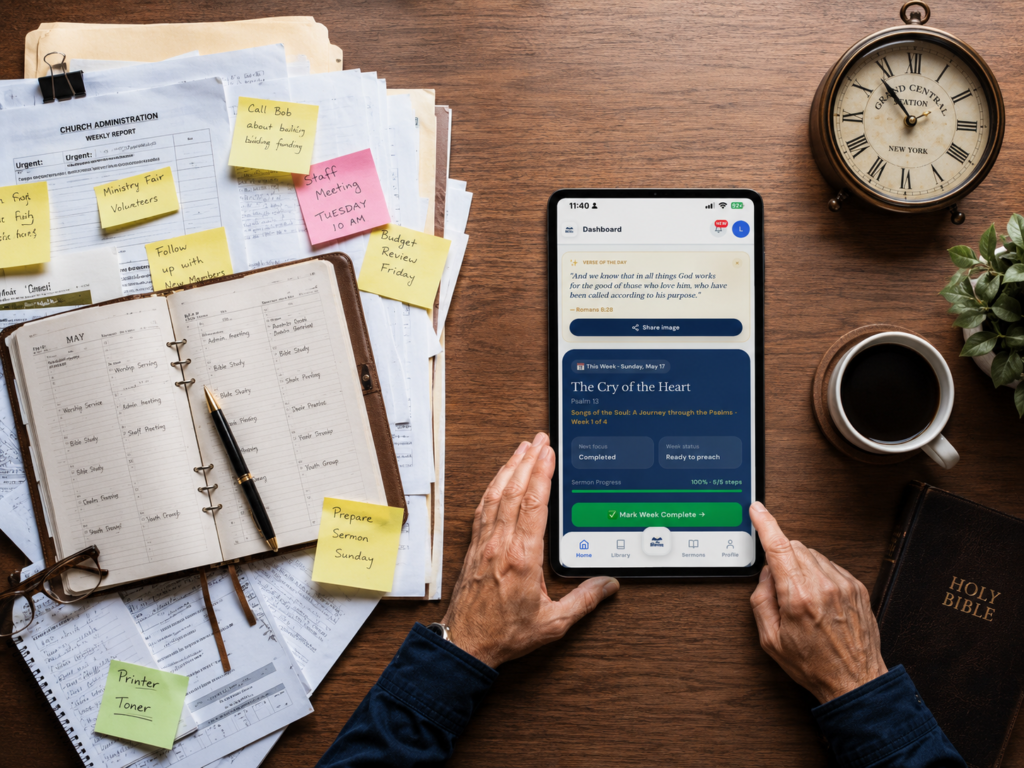
According to a 2024 Lifeway Research study, the average pastor spends 15 hours per week on sermon preparation alone. But a deeper look reveals that nearly 40% of that time—about six hours—goes to administrative and research tasks that could be automated or streamlined with existing AI tools. For pastors already stretched thin, this represents a significant opportunity to reclaim time for prayer, pastoral care, and deeper study.
This article examines the specific tasks where AI can make the biggest difference, the research behind pastoral time waste, and how tools like AI-assisted sermon platforms are changing the landscape—without replacing the essential human elements of ministry.
What the Data Says About Pastoral Time Waste
Barna’s 2023 report on pastoral well-being found that 54% of pastors feel overwhelmed by the volume of administrative tasks. The same study noted that pastors who delegate or automate routine work report 30% higher satisfaction in ministry. Yet many pastors remain skeptical of AI, viewing it as either a gimmick or a threat to authenticity.
The reality is more nuanced. AI excels at pattern recognition, data synthesis, and repetitive tasks—areas where pastors often get bogged down. A 2024 survey by the Hartford Institute for Religion Research found that 28% of pastors already use AI for sermon illustration research, and 19% use it for drafting email newsletters. Those who do report saving an average of 4.7 hours per week.
“The question isn’t whether AI can preach a sermon. It can’t. But it can handle the research that frees a pastor to preach with more clarity and conviction.” — Dr. Ryan Peterson, professor of homiletics at Fuller Seminary
Where the Six Hours Go: A Breakdown
Based on time-tracking studies and pastoral interviews, the six hours of waste typically fall into three categories:
- Research and commentary synthesis (2.5 hours): Searching for relevant commentaries, cross-references, and historical context. AI tools can scan thousands of sources in minutes and summarize key points.
- Administrative communication (2 hours): Drafting emails, newsletters, and social media posts. AI can generate drafts that pastors then personalize.
- Service planning and coordination (1.5 hours): Organizing liturgy, coordinating with volunteers, and managing schedules. AI scheduling assistants can reduce back-and-forth.
One pastor in Ohio, who asked to remain anonymous, told us he used to spend Monday mornings compiling research for Sunday’s sermon. After adopting an AI study tool, he cut that time from three hours to 45 minutes. “I still read the commentaries I trust,” he said. “But I don’t have to dig through twenty volumes to find what I need.”
Is This Biblically Sound? Addressing the Skepticism
Some pastors worry that using AI for sermon preparation undermines the spiritual discipline of study. It’s a valid concern. But the early church used the equivalent of technology—from scrolls to codexes to printing presses—to spread the gospel more effectively. AI is simply a new tool in that tradition.
The key is using AI as a research assistant, not a ghostwriter. Tools like Pastor Rhema, which focus specifically on sermon preparation, allow pastors to input a passage and receive contextual background, cross-references, and historical insights. The pastor still does the theological reflection, application, and prayerful crafting. AI handles the heavy lifting of data gathering.
“I was initially resistant,” said a pastor in Texas. “But I realized that spending less time on research meant more time for my congregation and my family. That’s a trade-off I’m willing to make.”
Practical Steps to Reclaim Those Six Hours
For pastors ready to experiment, here are three concrete steps:
- Identify your biggest time sink. Track your time for one week. Most pastors overestimate how long they spend on meaningful work and underestimate administrative drag.
- Start with one task. Choose a single repetitive task—like drafting a weekly email or finding sermon illustrations—and try an AI tool for two weeks. Measure the time saved.
- Evaluate and adjust. After the trial, assess whether the tool enhanced or detracted from your ministry. If it frees you for pastoral care, keep it. If it feels like a crutch, set it aside.
Platforms like Pastor Rhema are designed for this kind of targeted use. They don’t promise to write sermons; they promise to reduce research time. That’s a realistic and valuable goal.
The Bottom Line: Time Is a Stewardship Issue
Pastoral time waste is not just a productivity problem—it’s a stewardship issue. Every hour spent on tasks that could be automated is an hour not spent with a grieving family, a struggling couple, or in prayer. The six hours a week that AI can reclaim adds up to over 300 hours a year. That’s time that can be reinvested in the things that only a human pastor can do.
The goal is not to replace the pastor’s role but to restore it. As one veteran pastor put it, “I didn’t go to seminary to become an administrator. I went to shepherd people. If AI helps me do that better, I’m for it.”