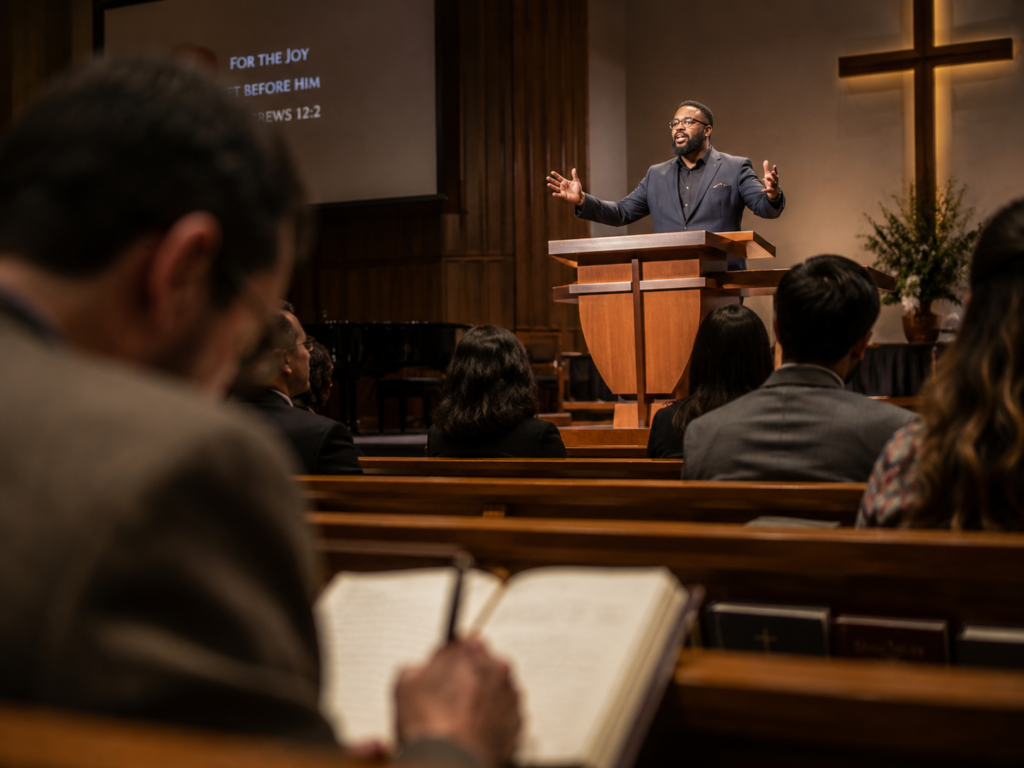
According to Barna’s 2025 State of the Church report, 38% of pastors now use some form of AI in ministry preparation — up from just 4% in 2022. As artificial intelligence quietly enters sermon prep, Bible study, and even worship planning, a pressing question emerges: Does AI have a place in the pulpit? This article offers a theologically balanced look at the AI ethics Christian theology pulpit ministry debate, weighing practical benefits against doctrinal concerns.
What Does the Research Say About AI Adoption in Churches?
Pew Research found in 2024 that 22% of Protestant pastors have used AI to generate sermon illustrations or outlines. Lifeway Research reports that among pastors under 40, that number jumps to 41%. Yet only 12% of congregations are aware their pastor uses AI — suggesting a gap between practice and transparency. The Hartford Institute for Religion Research notes that most early adopters are in suburban, multisite churches with larger staffs, while rural pastors remain skeptical or unaware.
One platform addressing this need is Pastor Rhema, an AI-powered sermon preparation tool that helps pastors research, outline, and refine messages. Early adopters report cutting weekly prep time by 40%, allowing more hours for pastoral care. But the tool also raises questions: does using AI for exegesis undermine the Spirit’s work in study?
Three Theological Tensions in the AI Ethics Christian Theology Pulpit Ministry Debate
Pastors wrestling with AI must navigate at least three tensions:
- Inspiration vs. Automation: If a sermon is partly generated by an algorithm, is it still “inspired”? Theologian John Piper has argued that preaching requires the “study and prayerful dependence on the Holy Spirit” — a process AI cannot replicate.
- Authenticity vs. Efficiency: Congregants expect their pastor’s voice. A 2024 Barna study found that 67% of churchgoers say they would feel “deceived” if they learned their pastor used AI to write a sermon without disclosure.
- Accessibility vs. Dependency: AI can help pastors with limited training produce better sermons. But critics warn it may discourage deep study of Scripture and theology.
“The danger is not the tool itself, but the heart that uses it,” says Dr. Russell Moore, editor of Christianity Today. “If AI becomes a shortcut around prayer and study, it undermines the pastor’s own formation.”
Practical Guardrails for Using AI in Sermon Preparation
How can pastors engage AI without compromising integrity? Several guidelines emerge from early adopters:
- Use AI for research, not revelation. Let AI gather historical context, cross-references, and illustration ideas — but reserve final sermon structure and application for prayerful reflection.
- Disclose your use. A brief note in the bulletin or a verbal acknowledgment builds trust. “I use AI to help me research, but the message is my own.”
- Limit AI to administrative tasks. Sermon series planning, email drafting, and social media posts are low-risk. Exegesis and application remain human domains.
- Stay theologically grounded. Run AI-generated content through a theological filter. Tools like Pastor Rhema include doctrinal checks, but no algorithm can replace a pastor’s discernment.
These guardrails help pastors navigate the AI ethics Christian theology pulpit ministry debate without losing sight of their calling.
Is This Biblically Sound? A Scriptural Framework
Scripture does not mention AI, but it offers principles. The Bereans “examined the Scriptures daily” (Acts 17:11) — a model of diligent study that AI can assist but not replace. Paul’s charge to “preach the word” (2 Timothy 4:2) implies personal conviction, not outsourced content. Jesus himself used everyday tools (fishing nets, coins) to illustrate truth; AI can be a similar tool, as long as it serves the message, not the messenger.
Yet the warning against “another Jesus” (2 Corinthians 11:4) applies: if AI distorts the gospel or replaces pastoral dependence on God, it becomes idolatry. The key is intentionality. A pastor who prays over an AI-generated outline is different from one who copies it verbatim.
The AI ethics Christian theology pulpit ministry debate ultimately hinges on the pastor’s heart. As with any tool — from commentaries to translation software — the question is not whether it is used, but how and why. AI can free pastors for more important work: prayer, counseling, and community presence. But it must never become a substitute for the Spirit’s leading.