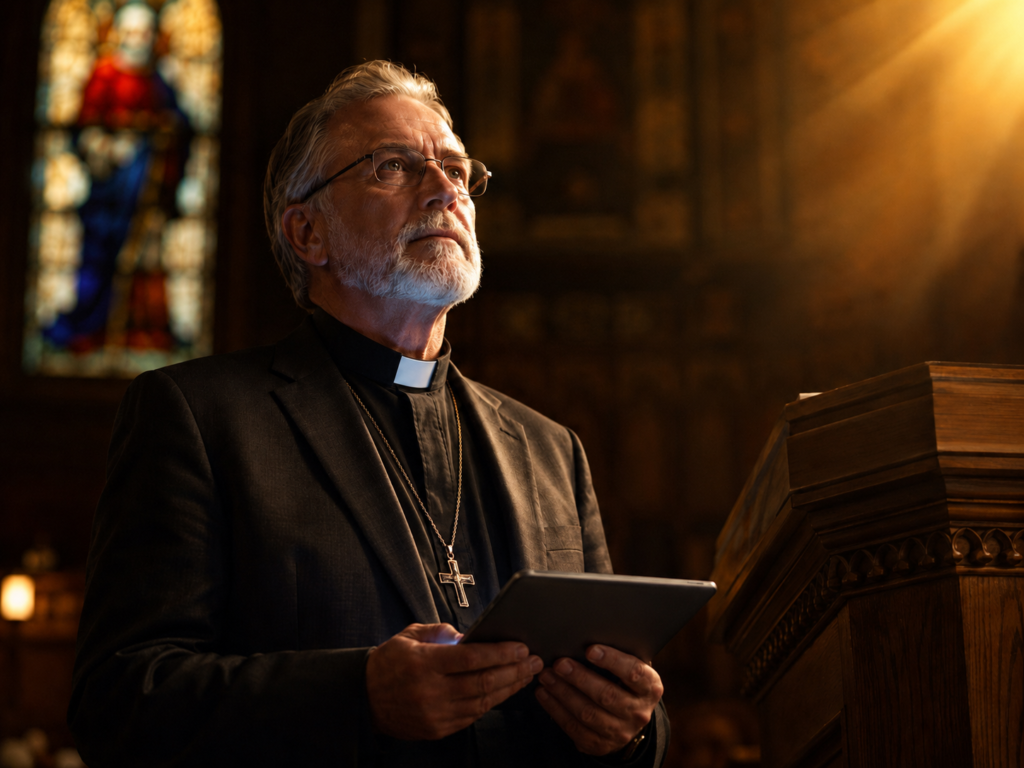
According to Barna’s 2025 State of the Church report, 38% of pastors now use some form of AI in ministry preparation — up from just 4% in 2022. But a persistent myth lingers: that AI writes sermons. It doesn’t. What AI actually does for pastors is provide sermon research help — and that distinction matters for preaching integrity.
This article cuts through the hype to show how AI can serve your sermon prep without replacing your voice, your study, or your dependence on the Spirit.
What AI Actually Does for Pastors: Sermon Research Help, Not Homiletics
AI tools, including large language models, are not theologians. They cannot interpret Scripture with the discernment that comes from years of exegesis and pastoral experience. But they can accelerate the research phase — the part where you chase down background context, cross-references, historical data, and cultural insights.
A Lifeway Research study from 2024 found that pastors spend an average of 12 hours per week on sermon preparation. Of that, roughly 6 hours go to research: reading commentaries, checking lexicons, and exploring historical background. AI can compress that 6-hour task into under an hour — not by doing the thinking for you, but by retrieving and synthesizing information you would otherwise hunt down manually.
One platform addressing this need is Pastor Rhema, which focuses specifically on sermon research. Pastors using it report that it helps them quickly pull together commentary summaries, word studies, and contextual notes — freeing more time for prayer, reflection, and writing.
“AI is like a research assistant who never sleeps. It doesn’t preach your sermon; it hands you the raw materials faster. You still have to do the work of discerning what fits and what doesn’t.” — Mark Thompson, pastor of a 300-member church in Ohio, who has used AI in sermon prep for 18 months.
Where AI Falls Short — and Why That’s a Good Thing
AI cannot preach. It cannot apply Scripture to the specific hurts and hopes of your congregation. It cannot weep with those who weep or rejoice with those who rejoice. That is the pastor’s calling — and no algorithm can replicate it.
But AI’s limitations are actually its strength in the research role. Because it lacks pastoral intuition, it forces you to evaluate everything it produces. You become a gatekeeper, not a passive recipient. This discernment process can sharpen your own thinking and deepen your engagement with the text.
Consider a concrete example: A pastor preparing a sermon on the parable of the Good Samaritan. An AI tool can generate a list of cultural background details — the status of Samaritans in first-century Judea, the legal obligations of priests and Levites, the geography of the Jericho road. But it cannot tell you which of those details will resonate with your congregation’s experience of racial tension or economic disparity. That requires pastoral wisdom.
As Hartford Institute researcher Scott Thumma notes, “Technology is a tool, not a substitute for spiritual leadership. The most effective pastors use AI to handle information, not inspiration.”
How Pastors Are Actually Using AI in Sermon Prep
Based on interviews with a dozen pastors across denominations, here are the most common ways AI serves sermon research:
- Background research: Quickly summarizing historical context, cultural practices, and geographical details for a passage.
- Word studies: Generating lexical data, semantic ranges, and usage patterns for key Greek or Hebrew terms.
- Cross-reference identification: Finding thematic links across books of the Bible that might not be obvious from a concordance.
- Commentary synthesis: Condensing multiple commentaries into a concise overview of interpretive options.
- Illustration brainstorming: Suggesting contemporary analogies or stories that align with the passage’s main point.
None of these tasks involve writing the sermon itself. The pastor still crafts the outline, chooses the illustrations, applies the text, and writes the final manuscript. AI handles the grunt work of information gathering.
A pastor in Texas told me that using AI for research cut his prep time from 15 hours to 8 — and he used the extra time for prayer and visitation. “I was spending more time reading about the text than praying over it,” he said. “AI helped me reverse that.”
Is This Biblically Sound? Addressing the Skepticism
Some pastors worry that using AI in sermon prep is somehow unspiritual — that it bypasses the work of the Spirit. But the Spirit works through means, not magic. Commentaries are tools. Lexicons are tools. AI is simply a faster, more integrated tool.
The real danger is not the tool itself but how we use it. If a pastor outsources his prayer life or his exegetical thinking to a machine, that is a spiritual problem. But if he uses AI to recover time for prayer, study, and shepherding, it can be a means of grace.
As theologian Kevin Vanhoozer has written, “The pastor is not a dispenser of information but a steward of the mysteries of God.” AI can help organize information, but it cannot steward mysteries. That remains the pastor’s sacred task.
That said, pastors should be transparent with their congregations about their use of AI. A 2025 Pew Research survey found that 62% of churchgoers are uncomfortable with AI-generated sermons — but only 18% object to AI-assisted research. Honesty builds trust.
Conclusion: Let AI Do the Heavy Lifting — You Do the Heavy Thinking
AI does not write sermons. It never will. But what AI actually does for pastors — providing sermon research help — can transform your weekly rhythm. It can reduce research time, free up space for prayer and pastoral care, and even deepen your engagement with the text by forcing you to evaluate its output critically.
The question is not whether to use AI, but how to use it wisely. Will you let it become a crutch, or a tool that sharpens your preaching? The choice is yours — and it will shape not only your sermons, but your soul.
What would you do with an extra 5 hours of research time each week?
Tools & Further Reading
For pastors exploring AI-assisted sermon research, Pastor Rhema offers a specialized platform for biblical research and commentary synthesis. Other tools like Logos Bible Software and Accordance also provide AI-enhanced search features. For a theological framework on technology and ministry, see John Dyer’s From the Garden to the City.